Why in-the-moment praise matters more than annual employee recognition

Most organizations don’t lack recognition programs. They lack recognition timing.
Annual awards, end-of-year bonuses, and performance-review praise are well-intentioned, but they often arrive too late to do what recognition is meant to do: reinforce the behaviors you want repeated, while people still remember the effort and context.
This isn’t a soft culture argument. It’s grounded in how human motivation works.
Let’s see what neuroscience says:
Dopamine is not only about pleasure, but it also acts as a reinforcement signal. Basically, it helps the brain learn which actions are worth repeating. Research on reward prediction error shows that when feedback follows behavior quickly, learning is stronger; when feedback is delayed, the association weakens. A foundational overview of this mechanism can be found in Wolfram Schultz’s work on dopamine and reward learning.
For HR and People Ops leaders, the lesson is simple: timing matters more than ceremony. Recognition needs to happen while effort is still emotionally and cognitively present, not months later.
Recognition works best when effort and reward are close in time
Recognition delivered close to the moment of effort creates a clear link between what someone did and why it mattered. That clarity helps individuals repeat successful behaviors and helps teams understand what “good” looks like in practice.
This is why many modern employee recognition ideas that actually work focus on frequency and immediacy rather than scale or formality:
Annual recognition tends to summarize outcomes. In-the-moment praise teaches behaviors.
Annual recognition looks backward. Culture is built forward.
End-of-year recognition programs often favor:
big wins, often financial
visible roles over enabling roles
recent wins over consistent effort
Right? Now let's consider a realistic scenario. A senior engineer quietly prevents incidents all year by reviewing dependencies and flagging risks early. At year-end, the team celebrates “overall impact,” but peers never learn which actions actually made the difference.
When recognition happens in the moment, contribution is captured while it’s still visible and teachable. Over time, this creates a shared understanding of how success is achieved, not just who achieved it.
Delayed praise increases turnover risk, especially among top performers
Recognition timing plays a measurable role in retention.
A large-scale study by Workhuman and Gallup found that employees who receive high-quality recognition are 45% less likely to leave their organization over a two-year period.
This matters because turnover is expensive. Replacing an employee often costs 1.5–2x their annual salary, factoring in recruitment, onboarding, and lost productivity:
High performers are particularly sensitive to delayed recognition. They invest discretionary effort, notice when it goes unseen, and disengage earlier when appreciation feels procedural rather than personal. By the time annual praise arrives, it may already feel irrelevant.
Why frequent recognition beats rare, high-stakes rewards
Many organizations rely on large but infrequent rewards — annual bonuses, milestone awards, long-service gifts. But behavioral research shows that frequent, smaller reinforcements are just as important in shaping habits and sustaining motivation.
This Harvard Business School research demonstrates that even symbolic, timely recognition can significantly improve morale and performance. The takeaway for People Ops teams is practical: recognition doesn’t need to be bigger. It needs to be sooner and more consistent.
Solution 1: build a rhythm for recognition (Kudos Friday)
One of the simplest ways to operationalize in-the-moment praise is to introduce a weekly recognition ritual, often referred to as Kudos Fridays. For tech teams, recognition can be bi-weekly at the end of the sprint.
Every week or two, peers publicly thank colleagues for specific contributions from the past few days. The value isn’t the format, it’s the cadence. A predictable rhythm:
reduces reliance on memory
normalizes peer-to-peer recognition
keeps appreciation visible and timely
For Slack-first teams, this practice fits naturally into existing workflows. It’s also why the Kudos feature is coming soon to BirthdayBot: to support these moments directly inside Slack without adding process or overhead. Follow BirthdayBot on LinkedIn or X to be the first to know about the Kudo feature release.
Public recognition turns values into lived behavior
Public recognition teaches culture by example. When teams celebrate actions, not just results, they show what ownership, collaboration, or customer focus actually looks like in practice.
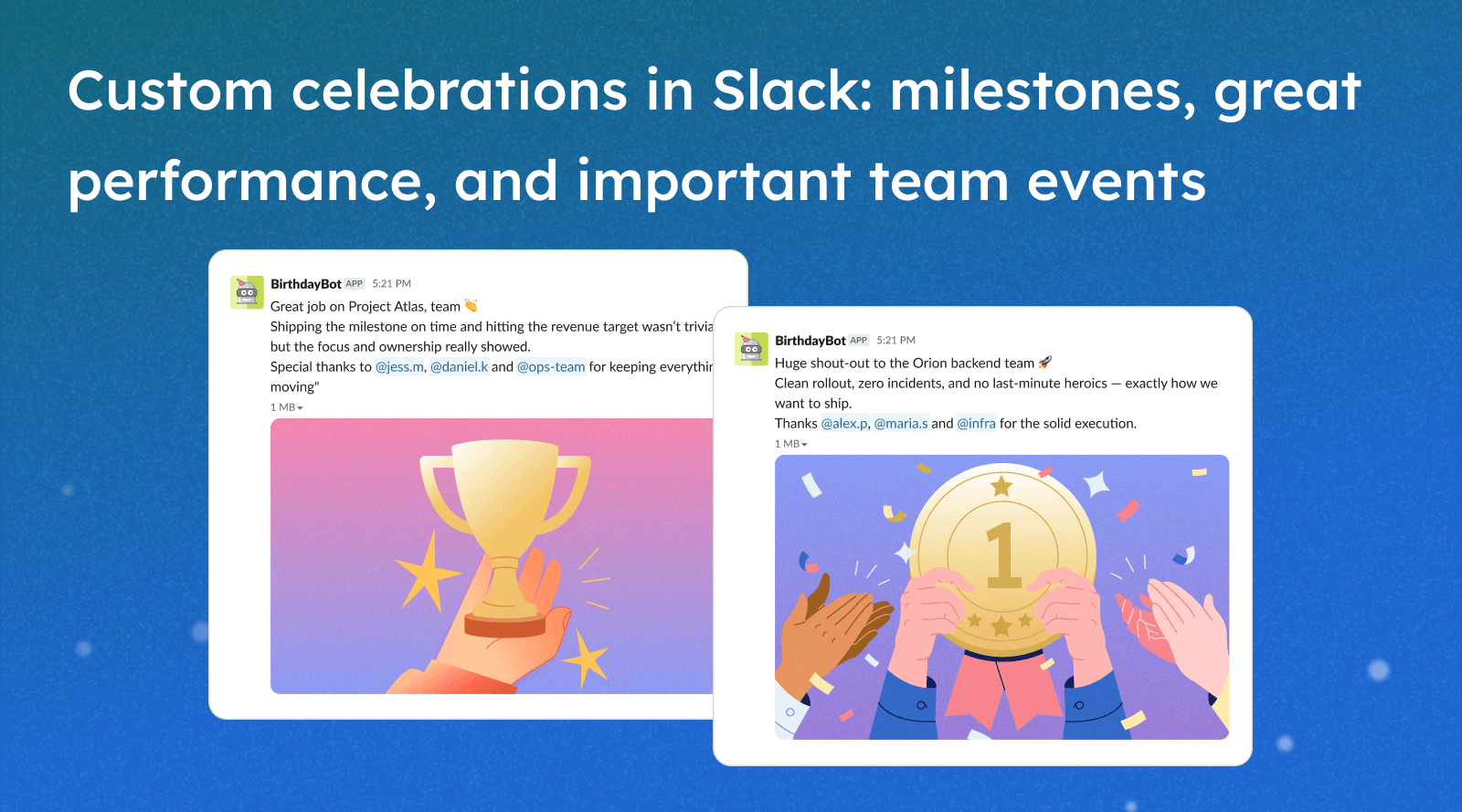
This is where celebrations in Slack play an important role, helping teams turn launches, saves, and milestones into shared cultural moments:
BirthdayBot’s Custom Celebrations feature builds on this idea by allowing teams to recognize not only birthdays and anniversaries, but also project wins, cultural milestones, and company-specific occasions — all scheduled and automated so nothing is missed. Because these moments don’t just boost morale. They make culture teachable.
Replace rare gifts with small, frequent treats
A single bonus every few years doesn’t reinforce day-to-day behavior. Small rewards tied closely to recognition do.
This is why many teams pair in-the-moment praise with modest, timely rewards: coffee, lunch, or gift cards – delivered right when the effort is acknowledged. For distributed teams, gift cards for employees offer a practical, globally fair option.
BirthdayBot’s Global Gift Cards make it possible to send spot rewards directly in Slack, letting recipients choose brands and currencies that suit them from hundreds of options in 60+ countries.
Don’t underestimate belonging moments
Belonging is reinforced through personal milestones.
Birthdays and work anniversaries are predictable signals of “you matter here.” When they’re consistently celebrated, they build baseline trust and attachment, especially for remote employees who miss informal office moments.
Systematizing these celebrations ensures that belonging doesn’t depend on one person’s memory and supports a stronger new-hire experience from day one:
Takeaways for HR and People Ops leaders
In-the-moment praise works because it aligns with how people learn, stay motivated, and feel valued. Annual recognition still has a place, but it cannot carry culture alone.
Teams that thrive:
Recognize effort while the context is fresh
Build weekly rhythms with small traditions, like Kudo Fridays
Make wins and values visible through public celebrations
Pair praise with small, timely rewards
Never forget the human milestones that create belonging
Recognition doesn’t need to be louder or more expensive. It needs to be timely, specific, and repeatable.
Ready to turn recognition into a habit?
BirthdayBot helps HR and People Ops teams:
Сelebrate birthdays and work anniversaries automatically
Кecognize team wins and cultural milestones with Custom Celebrations
Send timely, inclusive rewards with global multi-brand Gift Cards
Build a rhythm of appreciation that works for office, hybrid, and remote teams
And with Kudos coming soon to BirthdayBot, making in-the-moment recognition part of your weekly flow will become even easier.
👉 Try BirthdayBot for free and see how simple recognition can be when it fits naturally into your team’s day.